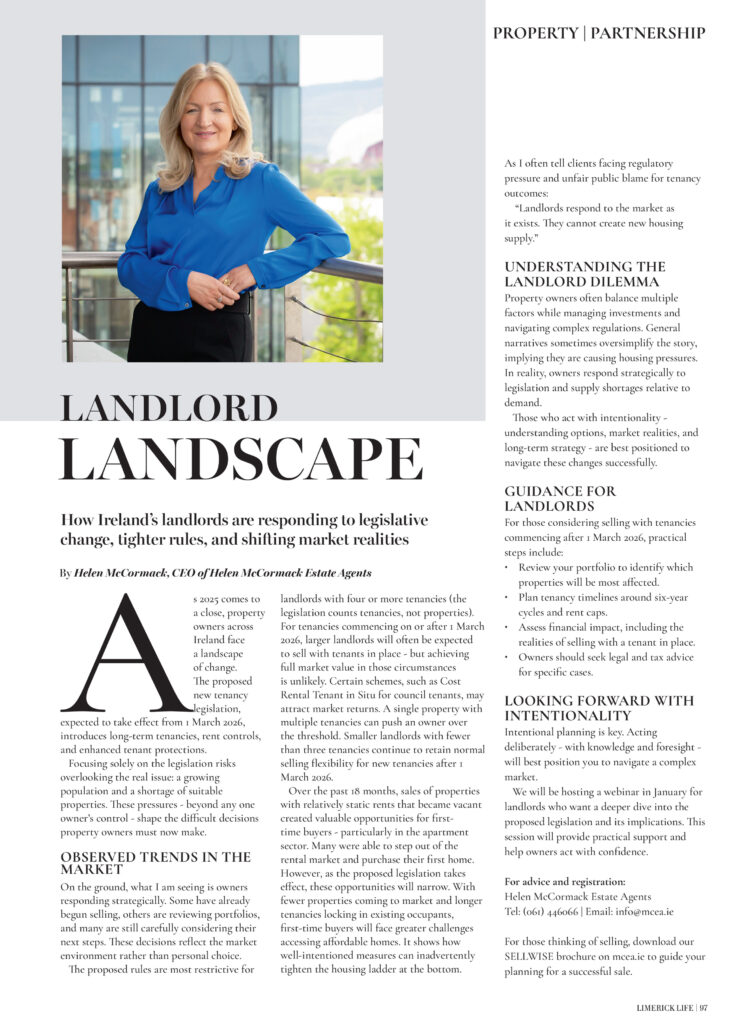
Landlord Landscape: How Ireland’s landlords are responding to legislative change, tighter rules, and shifting market realities

As 2025 comes to a close, property owners across Ireland face a landscape of change. The proposed new tenancy legislation, expected to take effect from 1 March 2026, introduces long-term tenancies, rent controls, and enhanced tenant protections.
Focusing solely on the legislation risks overlooking the real issue: a growing population and a shortage of suitable properties. These pressures — beyond any one owner’s control — shape the difficult decisions property owners must now make.
Observed Trends in the Market
On the ground, what I am seeing is owners responding strategically. Some have already begun selling, others are reviewing portfolios, and many are still carefully considering their next steps. These decisions reflect the market environment rather than personal choice.
The proposed rules are most restrictive for landlords with four or more tenancies (the legislation counts tenancies, not properties). For tenancies commencing on or after 1 March 2026, larger landlords will often be expected to sell with tenants in place — but achieving full market value in those circumstances is unlikely. Certain schemes, such as Cost Rental Tenant in Situ for council tenants, may attract market returns. A single property with multiple tenancies can push an owner over the threshold. Smaller landlords with fewer than three tenancies continue to retain normal selling flexibility for new tenancies after 1 March 2026.
Over the past 18 months, sales of properties with relatively static rents that became vacant created valuable opportunities for first-time buyers — particularly in the apartment sector. Many were able to step out of the rental market and purchase their first home. However, as the proposed legislation takes effect, these opportunities will narrow. With fewer properties coming to market and longer tenancies locking in existing occupants, first-time buyers will face greater challenges accessing affordable homes. It shows how well-intentioned measures can inadvertently tighten the housing ladder at the bottom.
As I often tell clients facing regulatory pressure and unfair public blame for tenancy outcomes:
“Landlords respond to the market as it exists. They cannot create new housing supply.”
Understanding the Landlord Dilemma
Property owners often balance multiple factors while managing investments and navigating complex regulations. General narratives sometimes oversimplify the story, implying they are causing housing pressures. In reality, owners respond strategically to legislation and supply shortages relative to demand.
Those who act with intentionality — understanding options, market realities, and long-term strategy — are best positioned to navigate these changes successfully.
Guidance for Landlords
For those considering selling with tenancies commencing after 1 March 2026, practical steps include:
- Review your portfolio to identify which properties will be most affected.
- Plan tenancy timelines around six-year cycles and rent caps.
- Assess financial impact, including the realities of selling with a tenant in place.
- Owners should seek legal and tax advice for specific cases.
Looking Forward with Intentionality
Intentional planning is key. Acting deliberately — with knowledge and foresight — will best position you to navigate a complex market.
For advice, queries or concerns you may have – get in touch with us for guidance and assistance to help you move forward with confidence.